It’s Not Just About the Note
When healthcare teams talk about documentation, the conversation usually starts with the SOAP note.
How fast can it be written? How accurate is it? How much time does it give back to clinicians?
Those questions are fair. Documentation is one of the most visible pressure points in clinical workflows, and when things feel strained, it is natural to focus on the final output. If the note improves, the assumption is that everything else should follow.
But that is not how most days actually play out.
Even when notes appear complete, the day still feels fragile. Healthcare providers frequently work extended hours, quality assurance teams re-examine patient charts, billing experiences delays, and patient access to services does not expand as much as leadership expected.
That is usually the point where it becomes clear the issue was never just the SOAP note.
Documentation Lives Around the Visit
In practice, documentation rarely breaks down at a single moment. It shows up before, during, and after the encounter.
Before the visit, it often starts quietly. Charts are incomplete. Prior context is missed. Care gaps are not visible. Problem Lists are not reviewed. Providers walk into rooms already behind, spending the first part of the visit searching instead of listening.
During the visit, nuance matters. The way a patient explains symptoms. The way a provider works through a differential diagnosis. Those details shape care, but they do not always carry cleanly into documentation without support that understands clinical context.
After the visit, the strain becomes more obvious. Review takes longer than expected. Something feels off. Downstream teams can hesitate because they are not fully confident in what the chart represents or an AI hallucination.
This is why pre-charting, real-time capture, and follow-through matter. Not as features, but as the difference between documentation that supports the day versus documentation that quietly complicates it.
Why Better Notes Alone Do Not Change Outcomes
Many documentation decisions are framed as execution problems.
If documentation feels slow, speed is assumed to be the answer. If it feels expensive, automation looks like the fix. If quality varies, standardization seems appealing.
That framing pushes teams towards binary comparisons. Autonomous AI or human. Faster or cheaper.
Clinical workflows are rarely that clean. They break down in the margins:
- When pre-charting does not happen
- When visits fall outside a template
- When handoffs leave room for interpretation
Transcribing the final note alone does not remove those risks. It usually just moves them to a different point in the day.
Where Autonomous AI Helps and Where It Has Limits
Autonomous AI has earned a role in documentation. It aids in rapid data capture and reduces patient-provider friction through ambient listening and NLP to transcribe and structure data into the EHR in the form of a narrative output and some recommendations. How deeply this interaction and customization goes depends on integration availability and complexity of the tool.
What it does not do well on its own is orient the work. It does not decide what matters most going into a visit. It does not recognize when a detail carries more weight because of a patient’s history. It does not flag uncertainty unless someone is looking for it. Autonomous AI does not go past the transcription itself to factor in what’s not being said yet still relevant to the documentation. In addition, its input lacks the structured data input required for most billing and compliance needs.
Without that layer of judgment, teams often find themselves reviewing notes more closely than expected, clarifying intent, or fixing gaps after the fact. The documentation work still exists. It just shows up later, often on the care team’s time, and at the risk of poorer health outcomes.
Why Humans in the Loop Changes the Outcome
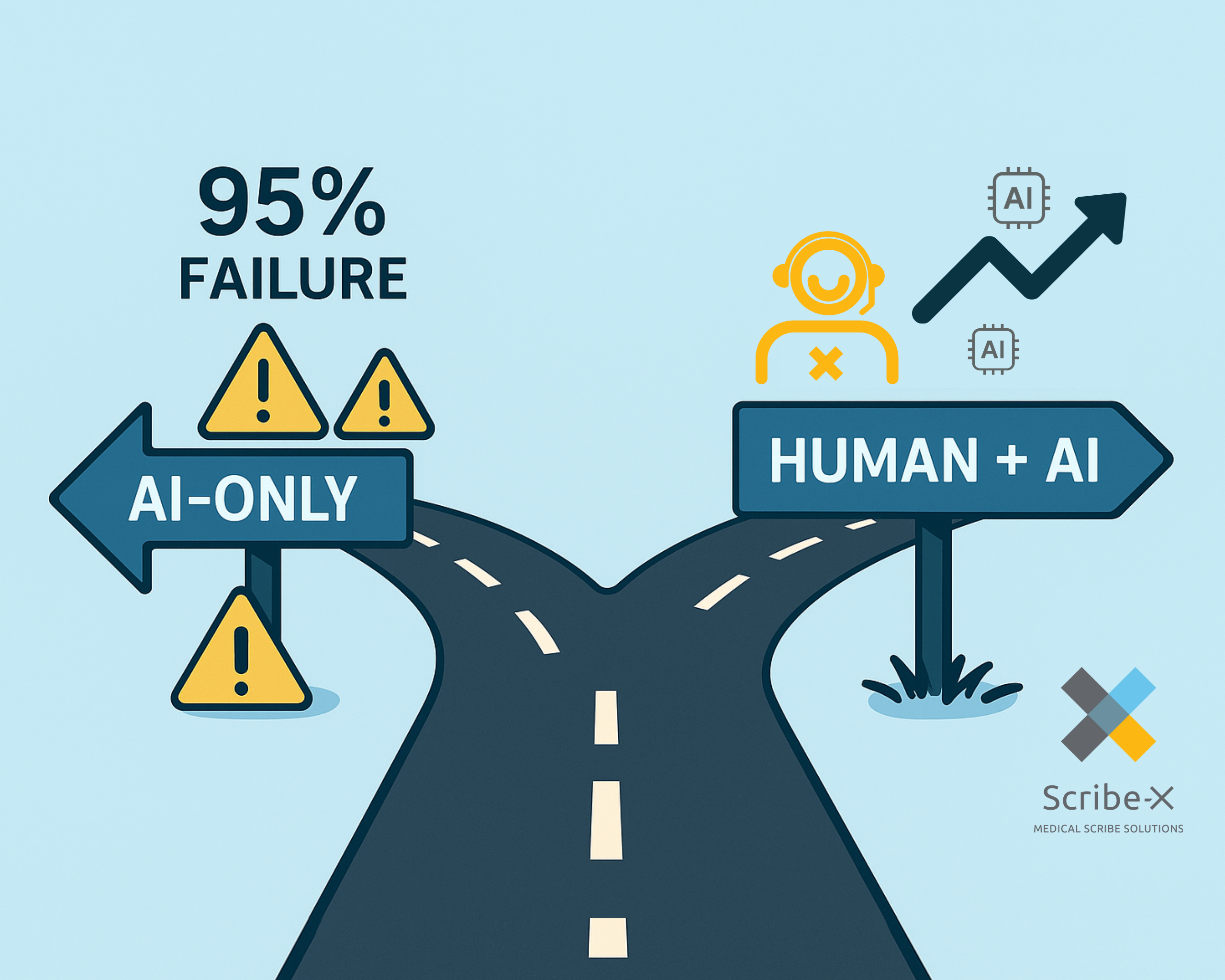
Humans in the loop is not about pushing back on technology. It is about designing documentation systems that reflect how care actually happens.
When trained specifically to each organization and provider, medical scribes bring workflow awareness and clinical judgment to support the care team at the highest level. They prepare charts before visits, identify care gaps and leverage population health tools. They follow the conversation as it unfolds and validate AI findings. They recognize when orders, referrals, or follow-ups need to be captured clearly and become the glue amongst so many different workflows and integration points.
When Humans+AI support this work, documentation becomes something different. It becomes support that surrounds the visit.
- Providers walk in prepared
- Visits stay focused
- Charts are ready to sign
- Care teams trust what they see
That consistency is what keeps documentation from spilling into nights and weekends – which is the whole point.
What Teams Are Actually Deciding
Healthcare leaders are not focused on documentation for its own sake.
They are trying to create predictable and quality patient care delivery while sustaining their care team and business model.
The real question is not just how fast a SOAP note gets written. It is whether the documentation approach supports care before, during, and after the visit, especially when conditions are not ideal.
In an upcoming article, we will look more closely at Autonomous AI scribes and human scribes. Where each works well. Where each struggles. And why human-guided AI models are optimizing to maximize the best of both worlds.
Documentation is not the outcome.
Support is.